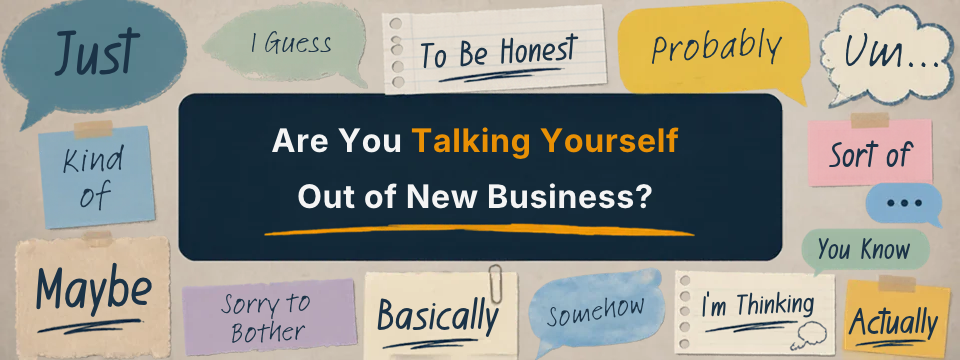
You’re sitting in a presentation and the speaker ends nearly every key point with “right?” By the fourth or fifth time, you’ve stopped paying attention and started counting how many times they say it. You’ve probably also started to wonder whether they believe what they’re saying.
That “right?” is one of many weak communication habits you hear every day from people at all levels, including executives. They’re so ingrained that most of us use them without noticing, and when we catch ourselves, we shrug it off as no big deal.
But it is a big deal, because it affects your business. Your communication habits shape how people see you, including how confident and trustworthy you seem, and how persuasive you are. That means a prospect may choose a competitor who sounds more sure of themselves, or a client may hesitate to act on your advice. When you sound like you’re questioning yourself or burying your point under qualifiers, people are more likely to dismiss you or put you off until later. When more than one person on your team communicates like this, those costs multiply across the company.
You sent a report to your CEO last week and haven’t heard back, so you follow up:
Sorry to bother you, but I’m just touching base on the report I sent last week. I’m wondering if you had a chance to review it and could let me know if you have any questions?
Many people soften their writing to sound polite but go too far with qualifiers when a clear, direct ask would suffice. Now compare:
I’m following up on the report I sent last week. What questions do you have? Happy to send any additional information. Thanks.
It’s still polite, but it gets straight to the point. It also invites a more useful response: the specific questions your CEO has, not a yes or no.
Watch for these in your own emails:
Phrases like these make your message seem less important, so it becomes something that can be put off. The result can be slower replies and delays on decisions that should be timely.
Unlike emails and direct messages that you can edit before sending, spoken habits reach people instantly. While they work as a crutch in the moment, they reduce the impact of what you’re saying and cost you credibility. When credibility drops, so does trust. The most common:
Prospects and clients draw conclusions about your company based on how your people communicate.
Think about how your team comes across on discovery calls, in recap emails and during pitches. Every “sorry,” “just,” “like,” “um” and “uh” chips away at the impression they need to make to earn prospects’ trust. If prospects sense uncertainty from your team, they’ll start to wonder whether your company is the right fit, and whether it can deliver what it promises.
Clients notice too. When the people they work with soften every recommendation and qualify every update, clients give that advice less weight and start to question the results. That affects whether they keep working with you, expand the relationship or refer you to people they know.
These habits also spread. We all influence one another’s communication styles, and newer employees take their cues from what they hear in meetings and see in emails, especially from senior people. The longer the pattern goes unaddressed, the harder it is to undo, and the more it becomes the way your company talks to prospects and clients.
A checklist of phrases to avoid rarely changes how anyone communicates. Change comes from hearing yourself the way others do, through practice and direct feedback, and from replacing each bad habit with a better one. Most people never get there on their own, because no one points it out, especially to a senior colleague.
In the meantime, people on your team continue to give unconvincing pitches, send soft follow-up emails and offer weak recommendations to the prospects and clients you want to win and keep.
Several senior managing directors at a commercial real estate firm were frustrated that many mid-level and junior staff often sounded too casual, unsure of themselves or nervous in interactions with clients. Because so much of their work depends on earning and keeping a client’s trust, the firm brought Point Road Group in to elevate how those employees communicate, through a targeted workshop focused on understanding their audience, strengthening their presence and delivering with confidence, as well as individual coaching with several key team members. The result was a more polished and self-aware team that prospects and clients take seriously and act on.
When you break bad communication habits, follow-ups get faster responses, recommendations drive action and you sound as capable as you really are. Now multiply that across your team. That’s what turns pitches into wins, keeps clients coming back and earns referrals.
If your communication needs to be stronger, executive coaching is the best and fastest way to improve it. When several people on your team could use the same help, our Communicating with Impact workshop delivers practical, interactive training that strengthens how your people write and speak, starting with their next prospect email or client meeting.



